Showing posts with label Portugal. Show all posts

Tuesday, 22 February 2022

António de Oliveira Salazar | Timeline

António de Oliveira Salazar (28 April 1889 – 27 July 1970) was a Portuguese economist who served as prime minister of Portugal from 1932 to 1968. Having come to power under the Ditadura Nacional ("National Dictatorship"), he reframed the regime as the Estado Novo ("New State"), a corporatist authoritarian government that ruled Portugal from 1933 until 1974. (excerpt from Wikipedia). 
Salazar was Minister of Finance in 1926 and from 1928 to 1940, becoming Prime Minister in 1932. A highly controversial personality after the Carnation Revolution of 1974, he was nevertheless considered the "greatest Portuguese" by a large margin of voters in a public contest based on the BBC's 100 Greatest Britons in 2007.

April 28, 1889 - Vimieiro, Santa Comba Dão, Portugal - António de Oliveira Salazar is born
May 16, 1889 - Vimieiro - Baptized
September(?) 1(?), 1896 - Santa Comba Dão - Salazar is enrolled in a public school, 2 km from his parents' house
August 11, 1899 - Viseu, Portugal - Salazar arrives in Viseu to take the Primary Instruction exam
October 1(?), 1900 - Viseu - 11-year-old Salazar wins a free place at Viseu's seminary
September(?) 1(?), 1905 - Viseu - Completes the Preparatory Cycle and begins studying Teology
March 25, 1906 - Viseu - Speaks at the inauguration ceremony of the monument commemorating the 50th anniversary of the Immaculate Conception, in front an audience that included the Bishop of Viseu
February 1, 1908 - While in Viseu - King Carlos I of Portugal and his heir-apparent, Luís Filipe, Prince Royal of Portugal, are assassinated in Lisbon by two members of "Carbonária", an anti-clerical, revolutionary, conspiratorial society
April 12, 1908 - Viseu - The newspaper "A Folha" publishes the article by Salazar entitled "Shameful Contrast". In it he criticized the indifference of Catholics to the gravity of the moment in relation to the Church and the Nation.
June 4, 1908 - Viseu - Publication of the article "conversando" (talking), in which he appealed to the faith of the students
October 1(?), 1908 - Viseu - Salazar finishes his Teology studies as the 1st in his class. He is invited to become a teacher at the "Via Sacra" religious school in Viseu. He teaches Literature, History and Mathematics there until 1910
December 1, 1909 - Viseu - The director of Via Sacra College asks him to give a public lecture on the future of Portugal
August 1(?), 1910 - Viseu - Speaker at the Conferece "Youth Education"
October 1(?), 1910 - Coimbra - Enrolls at the University of Coimbra to study law
October 5, 1910 - While in Coimbra - Implantation of the Republic in Portugal
June 1(?), 1911 - Viseu - Returns to Viseu for a German language exam and is approved
October 1(?), 1911 - Coimbra - Returns to Coimbra after an illness. At the University he becomes close friend with Father Gonçalves Cerejeira, future Cardinal and head of the Catholic Church in Portugal
March 14, 1912 - Coimbra - Publishes the article "sorrows do not pay debts", contrasting the vision of Pope Leo XIII with the reality of republican Portugal
October 1(?), 1912 - Coimbra - While studying Law, Salazar enrolls in the Modern Languages College to study English language and literature
December 8, 1912 - Coimbra - Public statement at the Academic Center for Christian Democracy (CADC)
August 15, 1913 - Coimbra - The Congregation of the Law College awards him a prize
October 21, 1913 - Coimbra - The Congregation of the Law College awards him another prize
May 2, 1914 - Porto, Portugal - Speaks at the Second Congress of Catholic Youth in Porto, on the theme "Democracy and the Church"
August 15, 1914 - Coimbra - The Law College Council awards Salazar the awards for Colonial Administration, Special Proceedings, Extra-Judicial Practice, Criminal Procedure and International Law
November 4, 1914 - Coimbra - Graduates with distinction, specialized in finance and economic policy
August 8, 1915 - While in Coimbra - Foundation of the Portuguese Catholic Center (CCP) in Braga
November 27, 1915 - Coimbra - Positions for new professors at the University of Coimbra are opened. For this purpose, candidates had to present a paper and a dissertation topic. Salazar applies and chooses "the Cereal Question. The Wheat"
March 16, 1916 - Coimbra - Invited to become the regent of economic policy and Finances at the Law School =(START)
March 31, 1917 - Coimbra - Salazar is appointed Assistant teacher after presenting a second work titled "Ágio de Ouro" (Golden Capital gain)
April 25, 1917 - While in Coimbra - The Head of Government resigns and was replaced by Afonso Costa, who was in favor of Portugal's participation in World War 1 and who takes over the government
March 1(?), 1918 - Coimbra - Declared unfit for military service
May 10, 1918 - Coimbra - 29-year-old Salazar is awarded his Law doctorate
December 14, 1918 - While in Coimbra - President Sidónio Pais is assassinated in Rossio Train Station (Lisbon) by a left-wing activist
March 14, 1919 - Coimbra - Salazar and 3 other professors at the University of Coimbra are suspended on charges of spreading monarchical propaganda
March 24, 1919 - Coimbra - A new judge is appointed to carry out the investigation and hear witnesses
April 7, 1919 - Coimbra - Salazar presents his written defense
November 22, 1919 - Lisbon - Attends the second National Congress of the Portuguese Catholic Center (CCP)
July 1(?), 1921 - Coimbra - Salazar presents himself again for the elections for Guimarães
July 25, 1921 - Lisbon - Attends the opening session of Parliament
July 26, 1921 - Coimbra - Returns to Coimbra
August 1(?), 1921 - Minho region, NW Portugal - Five-day vacation trip in the northwestern region of Minho
October 19, 1921 - While in Coimbra - "Bloody Night" - A military revolt brakes. The head of the Government, António Granjo, presents his resignation, but the President of the Republic , António José de Almeida, does not appoint a new executive. In this stalemate environment, on the night of October 19th to 20th, a group of civilians and military personnel, led by navy corporal Abel Olímpio, known as The "Golden Tooth", conducts the events of the so-called Bloody Night. A truck – the "ghost truck" – travels through Lisbon in search of various figures of the republican regime, who, forced into the vehicle, are later executed. In the "Bloody Night", among others, the Prime-Minister, António Granjo, and two protagonists of the Revolution of October 5, 1910, Machado Santos and Carlos da Maia, are murdered.
April 29, 1922 - Lisbon - Attends the two-day Congress of the Portuguese Catholic Center (CCP)
May 13, 1922 - Coimbra - Accepts the invitation to participate in the editorial staff of the Journal of Legislation and Jurisprudence
August 17, 1922 - Figueira da Foz - Goes to the coastal town of Figueira da Foz with his mother and sisters
August 26, 1922 - Vimieiro - Returns to Vimieiro after his mother falls ill and stays there the rest of the year
March 1(?), 1923 - Coimbra - Returns to Coimbra
July 4, 1924 - Braga, Portugal - Attends the National Eucharistic Congress where he speaks on "The Peace of Christ in the working class through the most holy Eucharist"
November 10, 1924 - Ávila, Spain - Travels to Ávila, Spain, where he spends two days
November 12, 1924 - Toledo, Spain - Spends a day at the Escorial, Toledo
November 13, 1924 - Madrid, Spain - Arrives in Madrid for a four-day stay
November 17, 1924 - Ávila, Spain - Spends another day in Ávila on his return
November 18, 1924 - Salamanca, Spain - Two-day visit to Salamanca on his return
November 20, 1924 - Coimbra - Returns to Portugal
March 31, 1925 - Lisbon - Salazar departs for Madeira Island to speak at two conferences
April 2, 1925 - Funchal, Madeira Island - Salazar arrives in Funchal
April 4, 1925 - Funchal - Conference "Secularism and Liberty"
April 6, 1925 - Funchal - Conference "Bolshevism and the Congregation"
April 16, 1925 - Lisbon - Returns to Lisbon
June 14, 1925 - Coimbra - Inaugural speech at the 10th Congress of the Spanish Association for the Progress of Sciences
May 28, 1926 - While in Coimbra - Coup d'état of the Army against the dying Republic, led by General Gomes da Costa, initially from Braga, then in the "slow march to Lisbon". President Bernardino Machado asks one of the revolutionary leaders, José Mendes Cabeçadas, a navy officer, to form government
June 4, 1926 - Lisbon - Salazar travels by train to Lisbon with two colleagues from Coimbra: Mendes dos Remédios (Public instruction) and Manuel Rodrigues (Justice), to meet with General Gomes da Costa and Mendes Cabeçadas. Unlike his colleagues, who take office immediately, Salazar doesn't like what he sees and decides to return to Coimbra, citing health reasons.
June 6, 1926 - While in Coimbra - General Gomes da Costa enters Lisbon at the head of a significant number of troops
June 10, 1926 - Coimbra - Mendes dos Remédios travels to Coimbra to try to persuade Salazar
June 12, 1926 - Lisbon - Salazar travels with Mendes dos Remédios to Lisbon, where a large delegation awaits them. After an interview with Mendes Cabeçadas, Salazar goes to the Ministry of Finance, where he takes office behind closed doors.
June 17, 1926 - Lisbon - Army officers and Gomes da Costa force the resignation of Mendes Cabeçadas. The three civil ministers (including Salazar) resign en bloc
June 18, 1926 - Coimbra - Salazar returns to Coimbra
July 9, 1926 - While in Coimbra - General Gomes da Costa is removed from power and goes into exile in the Azores
July 24, 1926 - Coimbra - Establishment of a commission to "elaborate the basis for the review and remodeling of State contributions and taxes, with the exception of customs". The presidency of this commission was attributed to Salazar
November 30(?), 1926 - Coimbra - Back in Coimbra
November 17, 1926 - Vimieiro - Maria do Resgate Salazar dies. Her son stays with her during her last nine days
February 3, 1927 - While in Coimbra - Military uprisings in Porto and Lisbon
February 7, 1927 - While in Coimbra - More military uprisings in Porto and Lisbon
June 30, 1927 - Lisbon - Presents his report on the reform of the tax system
July 1(?), 1927 - Coimbra - Interview with the newspaper "Diário de Notícias" on taxation, getting huge praise
August 12, 1927 - While in Coimbra - Attempted presidential coup in Lisbon
August 15(?), 1927 - Paris, France - Salazar, Cerejeira and Beleza dos Santos, an academic, travel abroad. Arrival in Paris
August 20(?), 1927 - Brussels, Belgium - Arrives in Brussels
August 25(?), 1927 - Liège, Belgium - Attends a Congress of the "Association Catholique de la Jeunesse Belge" (Belgian Catholic Youth Association)
September(?) 1(?), 1927 - Coimbra - Returns to Portugal (speculative date)
November 30, 1927 - Coimbra - Critic of the country's financial situation, until the 21st of December, publishes an article in 7 parts, "State Accounts: Management of 1926-1927", referring that at least, and contrary to what was usual, the real tax revenue related to the previous fiscal year had exceeded the forecast, which suggested that the budget had been a prudent and serious document: "And I won't dwell on the praise any longer, because it seems to me that I had some personal responsibility in it."
January 3, 1928 - Coimbra - Publishes an article in the newspaper "Novidades" on the effects of an international loan application
February 10, 1928 - Coimbra - Publishes the article "Deficit or superavit?"
March 18, 1928 - Coimbra - Speech before the Coimbra Workers' Union, under the theme "Two Economies"
April 19, 1928 - While in Coimbra - New Prime-Minister Colonel Vicente de Freitas communicates to the press that he is thinking of Salazar to Finance Minister.
April 26, 1928 - Lisbon - Arrives in Lisbon for talks with Vicente de Freitas
April 27, 1928 - Lisbon - Takes over as finance minister for the second time, on the eve of his39th birthday
May 8, 1928 - Lisbon - In the Council of Ministers, he informs his fellow ministers of the measures he intends to take. The next day, he calls the press
May 15, 1928 - Lisbon - Letter to Cerejeira, congratulating him for becoming a Cardinal
May 20, 1928 - Lisbon - First meeting of the Council for Budget Reform, an entity aimed at reducing expenditure in Public Administration
July 31, 1928 - Lisbon - A budget presented foresaw a surplus of 1,576,000 portuguese "escudos"
November 1(?), 1928 - While in Lisbon - "The Times" publishes an article praising him
February 1(?), 1929 - While in Lisbon - "The Times" publishes another article praising him
May 28, 1932 - Lisbon - Salazar is awarded the Great Cross of the Military Order of the Tower and Sword
June 28, 1932 - Lisbon - Salazar is invited to become the Prime-Minister (starts his new duties on July 7)
July 2, 1932 - While in Lisbon - King Manuel II dies in exile
March 19, 1933 - Lisbon - The corporatist constitution is approved in the national portuguese constitutional referendum
August 1(?), 1933 - While in Lisbon - A commerce Treaty is signed with Brazil in Rio de Janeiro
October 22, 1933 - Lisbon - The PVDE (State Surveillance and Defense Police) is formed
February 21, 1935 - Lisbon - Prize distribution session of the National Propaganda Secretariat, at which the poet Fernando Pessoa decided not to be present
March 13, 1935 - While in Lisbon - Article about Salazar in "The Times" of London
September 8, 1936 - Lisbon - Tagus Boat mutiny - communist sailors in the Portuguese Navy's two newest warships revolt, aiming to take part in the Spanish Civil War alongside the Republicans. The revolt fails and the convicted sailors are the first to be sent to the Tarrafal concentration camp in Cape Verde Islands
April 15, 1937 - Lisbon - Salazar receives an "Embassy" of portuguese residents in Brazil
May 25, 1937 - While in Lisbon - "Como se Levanta um Estado" (How to Raise a State), a book written by Salazar in 1936, is published, to be the «visiting card» of the Portugal pavilion at the Paris International Exhibition. In the book, Salazar criticised the Nuremberg Laws passed in 1935 in Germany, considering it regrettable that German nationalism was "wrinkled by racial characteristics so well marked," which had imposed "the legal point of view, the distinction between citizens and the subject – and this at the risk of dangerous consequences
July 4, 1937 - Lisbon - Two syndicalists attempt to assassinate Salazar. As he steps out of his limousine, a bomb explodes just 3 meters from him. Incredibly, the blast leaves him untouched, but his chauffer is rendered deaf
March 17, 1939 - Lisbon - A Portuguese-Spanish Treaty of Friendship and Non-Aggression, known as the Iberian Pact, is signed in Lisbon, just a few days before the end of the Spanish Civil War
September 1, 1939 - Lisbon - At the start of World War II, the Portuguese Government announced that the 600-year-old Anglo-Portuguese Alliance remained intact, but that since the British did not seek Portuguese assistance, Portugal was free to remain neutral in the war and would do so
September 5, 1939 - While in Lisbon - In an aide-mémoire, the British Government confirms the understanding
January 1, 1940 - Lisbon - Portugal's budget surplus amounts to 20 million pounds sterling, more than the country had received in 1928 with an international loan.
January 29, 1940 - Lisbon - Signing of an additional protocol to the Treaty of Friendship and Non-Aggression, in an attempt to ensure Spain's neutrality
May 15, 1940 - While in Lisbon - Britain recognises Salazar's important role when Douglas Veale, Registrar of the University of Oxford, informs him that the University's Hebdomadal Council had "unanimously decided at its meeting last Monday, to invite him [Salazar] to accept the Honorary Degree of Doctor of Civil Law"
May 20, 1940 - Lisbon - Arrival of the extraordinary embassy of Brazil, led by Francisco José Pinto, Chief of Staff of the Provisional Government of Getúlio Vargas
June 20, 1940 - Lisbon - Official opening of the Brazil pavilion at the "Portuguese World Exhibition" - Speech by Francisco José Pinto
June 26, 1940 - Lisbon - Four days after France's capitulation to Germany, Salazar authorised the Hebrew Immigrant Aid Society (HIAS-HICEM) in Paris to transfer its main office to Lisbon. 
July 21, 1940 - While in Lisbon - About 2,500 Gibraltarian refugees, mostly women and children, start arriving at Funchal (Madeira). They would remain there until the end of the war.
July 29, 1940 - While in Lisbon - A "Life magazine" article of July 1940 that praised Salazar's work on behalf of the Portuguese nation commented, "this year, for [the] first time in centuries, Portugal is important to America. It is the funnel through which to pour all the exchanges – of people and messages and diplomacy – between America and Europe. The war, by cutting the lines of intercourse to Northern Europe, has made Portugal what [one might say] geography intended – not a faraway corner of Europe but its front door."
August 14, 1940 - Lisbon - Departure of the extraordinary embassy of Brazil
September 24, 1940 - While in Lisbon - Winston Churchill writes to Salazar to congratulate him for his policy of keeping Portugal out of the war, avowing that "as so often before during the many centuries of the Anglo-Portuguese alliance, British and Portuguese interests are identical on this vital question."
May 6, 1941 - While in Lisbon - US Senator Claude Pepper defends the occupation of the Azores and Cape Verde
May 15, 1941 - Lisbon - Salazar signs an economic agreement with german diplomat Von Hoyningen-Huene
July 8, 1941 - Lisbon - Letter from Franklin Roosevelt, assuring him that it was in the interests of the United States that the Azores and other distant possessions remain under Portuguese control
July 29, 1941 - Lisbon - Letter to Franklin Roosevelt
February 11, 1942 - Seville, Spain - Salazar arrives in Seville
February 12, 1942 - Seville - Meetings with General Francisco Franco and Serrano Suñer
February 14, 1942 - Lisbon - Returns to Lisbon with Nicolás Franco
February 19, 1942 - While in Lisbon - The portuguese overseas territory of Timor is invaded by Japanese forces
August 22, 1942 - Lisbon - Disappointment with Brazil's entry into the war against the Axis
August 17, 1943 - Lisbon - The British request to use the Azores for their anti-submarine operations. Salazar accepts
October 7, 1943 - Vilar Formoso, Portugal-Spain border - Salazar departs from Vimieiro to the spanish border to secretly inform Count Jordana, Chief of Spanish diplomacy, of what was negotiated with the Allies
November 1(?), 1943 - While in Lisbon - The british begin using Lajes Airbase for anti-submarine operations
April 28, 1944 - Lisbon - Letter from Cardinal Cerejeira on his 55th birthday
May 1(?), 1944 - While in Lisbon - Washington turns to Brazilian diplomacy for Portugal to stop selling wolfram to Germany
October 1(?), 1945 - Lisbon - Salazar announces a liberalisation program designed to restore civil rights that had been suppressed during the Spanish Civil War and World War II in hopes of improving the image of his regime in Western circles. The measures included parliamentary elections, a general political amnesty, restoration of freedom of the press, curtailment of legal repression and a commitment to introduce the right of habeas corpus. The regime starts to organise itself around a broad coalition, the Movement of Democratic Unity (MUD), which ranged from ultra-Catholics and fringe elements of the extreme right to the Portuguese Communist Party. Initially, the MUD was controlled by the moderate opposition, but it soon became strongly influenced by the Communist Party, which controlled its youth wing.
October 22, 1945 - Lisbon - The PVDE becomes PIDE (International and State Defense Police), mostly known for its secret police activities
July 23, 1947 - Belém | Sintra, Portugal - Lunch with Eva Perón and President Carmona
January 1(?), 1948 - Lisbon - The MUD (Movement of Democratic Unity) is outlawed by the government
April 9, 1949 - While in Lisbon - Portugal signs the North Atlantic Treaty
February 27, 1950 - While in Lisbon - The Government of India asks the Portuguese government to open negotiations about the future of Portuguese colonies in India. Portugal asserts that its territory on the Indian subcontinent is not a colony but part of metropolitan Portugal and hence its transfer is non-negotiable, and that India has no rights to this territory because the Republic of India did not exist at the time when Goa came under Portuguese rule (wikipedia)
April 14, 1952 - Ciudad Rodrigo, Spain - Salazar travels to Ciudad Rodrigo for a meeting with General Franco
April 15, 1952 - Santa Comba Dão, Portugal - Returns to Portugal
June 11, 1953 - Lisbon - The Indian government withraws its diplomatic mission from Lisbon
November 16, 1953 - While in Lisbon - A Treaty of Friendship and Consultation (about portuguese descolonization in Africa) between Portugal and Brazil is signed in Rio de Janeiro
August 2, 1954 - While in Lisbon - Portuguese forces stationed in Dadra and Nagar Haveli surrender
September 1, 1955 - While in Lisbon - India shuts its consul office in Goa
February 18, 1957 - Lisbon - Queen Elizabeth II of Great Britain arrives in Lisbon for a 3-day
Queen Elizabeth and Salazar
(source: tsf.pt)
visit. Salazar welcomes the Queen
April 28, 1957 - Lisbon - 68th anniversary - Salazar retires from Professor at the University of Coimbra
May 10, 1958 - Lisbon - Presidential candidate General Humberto Delgado is interviewed in the "Chave d'Ouro Café". When asked what would be his attitude towards Salazar, Delgado says "Obviamente, demito-o!" (Obviously, I'll sack him!)
June 8, 1958 - Lisbon - Portuguese presidential election: The official tally was 76.4 percent for Américo Thomaz and 23.6 percent for Delgado. The regime's secret police force, PIDE, harassed and attacked Delgado voters and supporters, and there were many reports of widespread electoral fraud. For example, Salazar refused to allow opposition representatives to observe the counting of ballots (wikipedia)
January 12, 1959 - Lisbon - Humberto Delgado takes refuge in the Brazilian Embassy
March 7, 1959 - Lisbon - Letter to Juscelino Kubitchek, President of Brazil
April 20, 1959 - Lisbon - Humberto Delgado departs for Brazil
May 19, 1960 - Lisbon - Eisenhower makes an official visit to Portugal. Salazar welcomes the
Salazar and Eisenhower
(source: dn.pt)
American president
February 4, 1961 - While in Lisbon - 250 MPLA (Angola) guerrillas unsucessfully attack Luanda's fortress prison in an attempt to free "political prisoners"
March 15, 1961 - While in Lisbon - The UPA (Union of the Populations of Angola) launches an incursion into the Bakongo region of Northern Angola with 4,000-5,000 insurgents, unleashing an orgy of violence and destruction, killing and raping everyone they encountered, mostly women and children
June 9, 1961 - While in Lisbon - United Nations Security Council Resolution 163, calling upon the portuguese to desist from repressive measures and to extend every facility to the Sub-Committee on the situation in Angola
August 1, 1961 - While in Lisbon - The Republic of Dahomey (Benin) demands the withdrawal of the Portuguese from the Fort of S. João Baptista de Ajudá (Ouidah) and the Portuguese representative sets fire to the fort
December 14, 1961 - Lisbon - Salazar sends a message to Governor General of Portuguese India, Manuel António Vassalo e Silva, ordering the portuguese forces in Goa to fight to the last man
December 17, 1961 - While in Lisbon - Indian forces invade the three territories of Portuguese India: Goa, Daman and Diu
December 19, 1961 - While in Lisbon - Vassalo e Silva signs the instrument of surrender, ending 451 years of Portuguese rule in India
January 3, 1962 - Lisbon - Salazar addresses the Portuguese National Assembly: "We can not negotiate, not without denying and betraying our own, the cession of national territory and the transfer of populations that inhabit them to foreign sovereigns"
May 15, 1963 - Madrid, Spain - Meeting with General Francisco Franco in Madrid
July 31, 1963 - While in Lisbon - United Nations Security Council Resolution 180, affirmed that Portugal claiming its overseas territories as part of metropolitan Portugal was contrary to the principles of the Charter. The Council deemed Portugal's actions and attitude as seriously disturbing to peace and security in Africa
September 25, 1964 - While in Lisbon - FRELIMO carries out the first attack against Portuguese targets in Chai, Cabo Delgado Province, Mozambique
February 13, 1965 - While in Lisbon - Humberto Delgado and his brazilian secretary Arajaryr Moreira de Campos are lured into an ambush by the secret police (PIDE) near the border town of Olivença (Olivenza, Spain) and killed
August 6, 1966 - Lisbon - Inauguration of the Salazar Bridge (Today, 25th of April) over River Tagus
August 3, 1968 - Fort of Saint Anthony of Barra, Estoril - Salazar suffers a brain hemorrhage when he falls in a bath
September 27, 1968 - Lisbon - President Américo Thomaz appoints Marcello Caetano to replace Salazar as Prime-Minister
February 5, 1969 - Lisbon - Salazar leaves hospital and returns home
July 27, 1970 - Lisbon - António de Oliveira Salazar dies, aged 81 =(END)

Monday, 31 January 2022

Sebastião José de Carvalho e Melo, Marquis of Pombal | Timeline

Sebastião José de Carvalho e Melo, 1st Marquis of Pombal and 1st Count of Oeiras (13 May 1699 – 8 May 1782), known as the Marquis of Pombal (Marquês de Pombal), was a Portuguese statesman and diplomat who effectively ruled the Portuguese Empire from 1750 to 1777 as chief minister to King Joseph I. A liberal reformer influenced by the Age of Enlightenment, Pombal led Portugal's recovery from the 1755 Lisbon earthquake and modernized the kingdom's administrative, economic, and ecclesiastical institutions. During his lengthy ministerial career, Pombal accumulated and exercised autocratic power. (Intro from Wikipedia)

May 13, 1699 - Lisbon, Portugal - Sebastião José de Carvalho e Melo is born
January(?) 1(?), 1708 - Lisbon - His father, Manuel de Carvalho e Ataíde (1668-1720) is nominated for the prestigious position of cavalry officer of the Court
October 27, 1708 - Lisbon - King John V marries Anna Maria of Austria, daughter of the Holy Roman Emperor Leopold I
January(?) 1(?), 1715(?) - Coimbra - Studies Law, at the Faculty of Laws and at the Faculty of Canons of the University of Coimbra
March 15, 1720 - While in Coimbra(?) - His father dies in Lisbon, aged 43
January(?) 1(?), 1721(?) - Coimbra(?) - Serves in the army where he reaches the rank of corporal
January 23, 1723 - Lisbon - Carvalho e Melo marries D. Teresa de Noronha e Bourbon Mendonça e Almada, with whom he had lived in Lisbon
January(?) 1(?), 1724 - Gramela, N. of Pombal, central Portugal - He retires from Lisbon to a family farm in the "Coimbra countryside", where he would stay for 7 years taking care of its administration.
October 24, 1733 - Lisbon - Conference of the Royal Academy of Portuguese History. Carvalho e Melo is elected to the Academia dos Ilustrados (Academy of the Illustrated) =(START)
July 19, 1738 - Lisbon - Carvalho e Melo is accepted as a family member of the Holy Office, an important step towards social recognition
October 2, 1738 - Lisbon - Carvalho e Melo is named Ambassador to London. Bullfight at Junqueira with the presence of the royal family
October 8, 1738 - Lisbon - Carvalho e Melo sails for London on board the british ship "King of Portugal"
October 19, 1738 - London, England - Arrives in London, where his cousin and predecessor awaited him
November 29, 1738 - London - Carvalho e Melo is officially received in London
January 7, 1739 - While in London - Teresa de Noronha, first wife of Sebastião José de Carvalho e Melo, dies in Lisbon.
March 5, 1739 - London - Carvalho e Melo delivers the credentials of Portuguese ambassador in London
November 16, 1739 - London - Letter to D. Luís da Cunha
May 15, 1740 - London - Elected Fellow of the Royal Society
May 8, 1741 - London - Letter from D. Luís da Cunha, about the problem of Hungary and the need to proceed negotiations with Prussia
May 10, 1742 - While in London - King John V has a bout of paralysis at the age of 52 that leaves him partially paralyzed on the left side of his body
May 23, 1742 - While in London - Consort queen Maria Anna de Austria takes over the regency of the Kingdom while the king recovers
January(?) 1(?), 1743 - London - Carvalho e Melo asks permition to returns to Lisbon for being ill
November 21, 1743 - Lisbon, Portugal - Carvalho e Melo returns to Lisbon
August 22, 1744 - Lisbon - He is called to the Royal Palace, where he learns of the mission that would be entrusted to him
September 14, 1744 - Lisbon - Carvalho e Melo receives instructions to take royal letters to the Emperor and Queen of Hungary, receiving monetary assistance from the crown for travel expenses
October 8, 1744 - Lisbon - Carvalho e Melo leaves for Vienna, via London, in order to inform George II of his mission in Austria.
Deember 1(?), 1744 - London - He disembarks first in London to attend to embassy business and to follow the India Company's plan that insisted on proceeding.
May(?) 1(?), 1745 - The Hague, Netherlands - Passage through The Hague on the way to Vienna
June(?) 1(?), 1745 - Hannover, Germany - Passage through Hannover on the way to Vienna
July 17, 1745 - Vienna, Austria - Arrives in Vienna
September 13, 1745 - Frankfurt, Germany - Accompanies Maria Theresa (future Holy Roman Empress) and the Court to Frankfurt for the imperial election. Francis III Stephen is elected Holy Roman Emperor
December 13, 1745 - Vienna - Carvalho e Melo and Eleonore Ernestina, Countess of Daun sign the nuptial contract
December 18, 1745 - Vienna - Carvalho e Melo marries Eleonore Ernestine Eva Wolfganga Gräfin von und zu Daun auf Sassenheim und Callaborn (Countess of Daun)
May 31, 1746 - Vienna - Letter to Marco António de Azevedo Coutinho, Secretary of State for Foreign Affairs and War: "In the instructions with which I left that court, the King ordered me to be called a simple wayfarer. In the letters of belief he named me, whoever wrote, emissary. And this resulted in two things. First, that when I arrived here, to make up for the lack of means, which I did not have in my faculties, I said that, in fact, I was a traveler, and had left my home in England , because my mission in this court was restricted to an object, which could not be of long duration. Second, that the said word emissary caused this court notable strangeness, seeming to it absolutely new, and not finding it in accordance with the gravity of the case. business, which I came to deal with"
August 8, 1746 - Vienna - Letter to Marco António de Azevedo Coutinho, Secretary of State for Foreign Affairs and War: "The situation in which I spoke to the Empress was and is such that her interests can decide, not only on the conservation of the house in Austria, but on the freedom of the whole of Europe if general peace is achieved as had hitherto been projected, and if the States of the House of Austria are divided by it; if the two maritime powers (England and Holland) do a public confession of their present impotence, to support the indivisibility of the same States and their greater future impotence, after the aforementioned States were once divided: in such a case all the treaties, which we have hitherto made for the purpose of our conservation, on one hand would be useless to support us, because in spite of them they would be obliged to do what France wanted; on the other hand, they would remain in force to afflict us; because England and Holland, as long as they are not completely annihilated, always continue to enjoy their observance, and to do us the vexations that they bring with it. If, on the other hand, those allies of ours increase their power and strength, through our alliance with Spain, everything remains, at least, in the old state"
October 18, 1746 - Vienna - Empowered to negotiate and sign agreements concerning mediation between Rome and Vienna after the death of Philip V of Spain
May 1(?), 1748 - Vienna - Expresses the desire to return to Portugal, complaining of having run the risk of going blind
November 15, 1748 - Vienna - Letter to Marco António de Azevedo Coutinho, Secretary of State for Foreign Affairs and War: "With the negotiation of mediation between the crowns of Rome and Vienna at that time, mediation that was to be negotiated eight hundred leagues from Lisbon, in the climate of Germany much colder than that of England, where my health was ruined and a mediation that did not promise the slightest hope of being effective, against the strong and already clear opposition of the ministries, with whom it should be negotiated; presenting, I mean, this remote and almost impossible negotiation, demonstrated the facts that there was no lack of someone to inculcate me for it... There is, in political books, and in the examples of ministerial history, intrigue more trivial and shabby than that in which similar commissions are promoted, very remote and extremely difficult. , the ministers that some particular interest seeks to remove from the shadow of the throne and ruin the master's concept..The aforementioned gruesome means had the aim of excluding me from the establishment of the aforementioned Oriental Company, so that I could not have the smallest part in it."
May 31, 1749 - While in Vienna - King John V finally requests him to end his Envoyship
August 30, 1749 - Vienna - Carvalho e Melo holds his farewell audience in Vienna
September 3, 1749 - Vienna - Carvalho e Melo departs for Lisbon, via France and Spain
December 20(?), 1749 - Lisbon, Portugal - Arrives in Lisbon
May 19, 1750 - Lisbon - Marco António de Azevedo Coutinho, diplomat and Secretary of State for Foreign Affairs and War, dies in Lisbon.
July 31, 1750 - Lisbon - King John V dies, aged 60. Regent Queen Maria Anna of Austria gives up power to their eldest son Joseph I of Portugal
August 1, 1750 - Lisbon - Joseph I ascends to the throne of Portugal
August 2, 1750 - Lisbon - The new King, Joseph I, names Sebastião José de Carvalho e Melo as one of his three ministers
August 5, 1750 - Lisbon  - Carvalho e Melo is designated to the Secretary of Foreign Affairs and War
September 7, 1750 - Lisbon - Solemn act of the acclamation of King Joseph
September 25, 1750 - Lisbon - Letter from ex-ambassador Manuel Teles da Silva, Count of Tarouca, in Vienna
January(?) 1(?), 1751 - Lisbon - Founds Banco Real (Royal Bank) and establishes a new structure to manage the collection of taxes, centralized by the Real Fazenda de Lisboa (Royal estate of Lisbon), under its direct control
February 5, 1751 - Lisbon - The "Junta", summoned by Carvalho e Melo, gives the unanimous opinion that negotiations for the implementation of the Treaty of Madrid should be broken off.
September 21, 1751 - Lisbon - Instructions by Carvalho e Melo for the mission to demarcate the southern borders of Brazil with the Spanish possessions, directed by Gomes Freire de Andrade, future 1st Count of Bobadela.
January(?) 1(?), 1753 - Lisbon - Creation of the Company of Commerce of Portuguese Asia, aimed at controlling and promoting commercial activity with the Portuguese State of India and with China, strengthening the practice of mercantilism in the kingdom
August 14, 1754 - Lisbon - The Queen-Mother Maria Anna of Austria dies, aged 70
June 7, 1755 - Lisbon - Creation of the Grão Pará and Maranhão General Company
Earthquake, Tsunami and fires in Lisbon, 1755
November 1, 1755 - Lisbon - Great Lisbon Earthquake at 09h30 in the morning on "All SaintsDay". It lasted "lasted from three and a half to six minutes, causing fissures 5 metres (16 ft) wide in the city center. Survivors rushed to the open space of the docks for safety and watched as the sea receded, revealing a plain of mud littered with lost cargo and shipwrecks. Approximately 40 minutes after the earthquake, a tsunami engulfed the harbor and downtown area, rushing up the Tagus river "so fast that several people riding on horseback ... were forced to gallop as fast as possible to the upper grounds for fear of being carried away." It was followed by two more waves. Candles lit in homes and churches all around the city for All Saints' Day were knocked over, starting a fire that developed into a firestorm which burned for hours in the city, asphyxiating people up to 30 metres (98 ft) from the blaze" (wikipedia). The catastrophe causes about 50,000 deaths
November 2, 1755 - Lisbon - Carvalho e Melo consults the cardinal-patriarch of Lisbon on the fate to be given to the bodies of those killed in the earthquake
November 3, 1755 - Lisbon - Letter from ex-Ambassador Manuel Teles da Silva, Count of Tarouca, in Vienna
November 8, 1755 - Lisbon - New earthquake in Lisbon
November 11, 1755 - Lisbon - New earthquake in Lisbon
November 14, 1755 - Lisbon - Issues orders to rebuild "Ribeira das Naus" (Navy arsenal on the Tagus River)
November 18, 1755 - Lisbon - Carvalho e Melo, as Secretary of State for Foreign Affairs, officially informs Portuguese diplomats abroad of the earthquake
December 11, 1755 - Lisbon - New earthquake in Lisbon
December 21, 1755 - Lisbon - New earthquake in Lisbon
December 24, 1755 - Lisbon - Presentation by the chief engineer of the Kingdom Manuel da Maia of the first plan for the reconstruction of Lisbon
April 9, 1756 - Lisbon - Manuel da Maia tasks a group of engineers with studying an urbanization plan for the western part of the city.
May 6, 1756 - Lisbon - Carvalho e Melo is appointed Secretary of State of Internal Affairs of the Kingdom, also known as Prime-Minister, after the death of Pedro da Mota e Silva
July 16, 1756 - Lisbon - The General Company of Agriculture of the Vineyards of High Douro is created on the initiative of the Marquis of Pombal. Its creation was part of an environment of overproduction and crisis in the quality of Port wine. This chaotic state was mainly due to an attempt at easy profit. In order to maintain the level of exports to England, at a time of underproduction, the Douro farmers choose to weaken the final product, admitting wines from other wine regions and adding elderberries, among other harmful products. Exports fall drastically, degenerating into a crisis
August 31, 1756 - Lisbon - Carvalho e Melo takes over as State Secretariat of the Kingdom's businesses
October 1(?), 1756 - Lisbon - Father Gabriel Malagrida, an italian jesuit, publishes an opuscule in Lisbon, pointing the 1755 Lisbon's earthquake as a divine punishment for the spiritual negligence of the portuguese people and its Court
November 1, 1756 - Lisbon - Carvalho e Melo resents Malagrida's implicit criticism of the government, and persuades King Joseph to banish him to Setúbal and to have all Jesuits removed from the Court
February 23, 1757 - While in Lisbon - In Porto, about 5,000 insurgents besiege the house of Bernardo Duarte de Figueiredo, judge administrator of the Douro Company
May 1(?), 1757 - Lisbon - In Pará (Brazil), laws are published that extinguish the missions and in which the Indians of Brazil are declared free
May 3, 1757 - Lisbon - The Directory Law is issued, proposing the regulation of various colonial practices, establishing educational criteria, workforce management and relations between indigenous and settlers
August 27, 1758 - Lisbon - Mourning in the Court: Queen Maria Bárbara, King Joseph's sister, dies in Spain. The Directory Law is confirmed
September 3, 1758 - Lisbon - King Joseph I was riding incognito in a carriage traveling along a side street on the outskirts of Lisbon. He would return to the Ajuda tents for a night with his lover the “little marquess” Távora D.Teresa Leonor. Along the way, the carriage is intercepted by three masked men, who shoot at the occupants. The King is shot in the arm and shoulder but survives. Although probably innocent, the Távora family, which included the Duke of Aveiro and the Count of Alvor - Carvalho and Melo's political enemies - are implicated and arrested with their families soon after. The sentence ordered the execution of all, including women and children. Only the interventions of Queen Mariana and Princess Maria (future Queen Maria I) saved most of them.
September 7, 1758 - Lisbon - King Joseph resumes the government due to his complete recovery
December 12, 1758 - While in Lisbon - The Marquis of Távora, his two children, and the Count of Atouguia, his son-in-law, are arrested and imprisoned in the cages in the animal yard of the Palace of Belém. The Duke of Aveiro, his wife and children, as well as some of the his servants, are imprisoned in his palace in Azeitão
December 14, 1758 - Lisbon - The marquises of Távora, mother and daughter-in-law, and the countess of Atouguia are arrested and sent to different convents
December 18, 1758 - Lisbon - The defendants are declared “pilgrims, vagabonds, not belonging to any civil society and deprived of the birthplace and denomination of Portuguese”, as had been requested by the Judge of the People and the House of the Twenty Four
December 22, 1758 - Lisbon - Due to the attack on the king, searches are carried out in the Jesuit Houses.
January 11, 1759 - Lisbon - Several Jesuits are arrested, among them Father Gabriel Malagrida, being sent to the Junqueira fort
The execution of the Távoras
January 13, 1759 - Belém, Lisbon - The Távora family is gruesomely tortured and executed in public (with the Court present). The events greatly affected the future queen, who began feeling an intense hatred towards the Prime Minister Carvalho e Melo
January 19, 1759 - Lisbon - Order is given to take the goods of the priests of the Society of Jesus
April 19, 1759 - Lisbon - Creation of the Commerce Class, initiating the reform of education
June 6, 1759 - Lisbon - Carvalho e Melo is made "Count of Oeiras" by royal letter
June 28, 1759 - Lisbon - To remedy the deficiency of structures and teachers, through a charter dated June 28, 1759, the government instituted the Royal Classes, serving the elementary teaching of Letters and Humanities, as well as providing classes in Latin Grammar, Greek and Rhetoric. . This document highlighted the "pernicious" character of the Jesuit teaching method, stating that one of the objectives of the changes was to bring the Portuguese system closer to that in practice in the more civilized nations of Europe. In addition, the position of Director of Studies was created, which should supervise the progress of the reforms, and the admission of professors by competition was defined.
August 13, 1759 - Lisbon - Creation of the General Company of Pernambuco and Paraíba (Brazil)
September 3, 1759 - Lisbon - The law of expulsion is published, in which the members of the company of Jesus (jesuits) are declared "corrupted, deplorably alienated from their holy institute... Rebels, traitors, adversaries and aggressors..." against the royal person and his States, being  "denatured, proscribed and exterminated", and having to be expelled from all Portugal and its domains.
September 16, 1759 - Lisbon - The 133 members of the Society of Jesus who were detained at Quinta de Azeitão, in the Duchy of Aveiro, were embarked on the brig "São Nicolau", bound for Civittavechia, port of the Papal States, and others on the brig "São Boaventura", which departs for Genoa
July 22, 1760 - Lisbon - The "Gazeta de Lisboa" (Lisbon Gazette) resumes its publication, after having stopped its publication due to the earthquake of 1755.
February 1(?), 1761 - Lisbon - The Count of Oeiras prohibits the importation of slaves into mainland Portugal and India, not for humanitarian reasons, which were foreign to their nature, but because they were necessary labor in Brazil. At the same time, it stimulated the trade in black slaves to that colony, and two companies were founded, with the support and direct involvement of the Marquis of Pombal - the Companhia do Grão-Pará e Maranhão and the Companhia Geral de Pernambuco and Paraíba - whose activities The main one was precisely the slave trade, mostly Africans, to Brazilian lands.
February 12, 1761 - Lisbon - Signing of the Treaty of Pardo, in which Portugal and Spain agreed to annul the Treaty of Demarcation of Santo Ildefonso of 1750, and to return to the previous situation, with Portugal maintaining the Sacramento Colony, on the estuary of the River Plate, and the Spaniards the region of the Missions Jesuits on the Uruguay River.
March 7, 1761 - Lisbon - The Count of Oeiras creates the Colégio dos Nobres (College of the Nobles)
September 19, 1761 - Lisbon - The transport of slaves from ports in Africa, America and Asia to Portugal is prohibited, and the slave trade in Portugal is prohibited, with the intention that the slaves do not leave Brazil.
September 21, 1761 - Lisbon - Finding the works attributed to Malagrida as heretical, he was sentenced to death. The italian jesuit is strangled at the garrotte in Rossio Square. His corpse is then burned on a bonfire and the ashes are thrown into the Tagus river
December 22, 1761 - Lisbon - The Count of Oeiras creates the General Treasury by charter, as the top institution of the Portuguese tax administration aimed at centralizing the current management of public accounts.
March 11, 1762 - Lisbon - General Tirawley, former british ambassador in Lisbon, returns to his post to inform George III about portuguese preparations for war with Spain and France
March 16, 1762 - Lisbon - The ambassadors of France and Spain deliver to the Portuguese Government a "pro-memory" demanding that Portugal adhere to the Bourbon Family Pact, signed in 1761, and exclude from its ports the ships of the British and their allies in exchange for the protection of their domains overseas. Spanish forces begin to concentrate on the borders
March 20, 1762 - Lisbon - The Portuguese Government refuses the offer of cooperation by the two countries in the defense of Portuguese overseas domains, effectively rejecting adherence to the Family Pact.
April 1, 1762 - Lisbon - In a new "pro-memory" the ambassadors of France and Spain demand that the Portuguese Government participate in the war against Great Britain, informing that Spanish troops will invade Portuguese territory if Portugal does not prevent the use of Portuguese ports by British ships
April 5, 1762 - Lisbon - The Portuguese Government refuses to collaborate with France and Spain in the war against Great Britain.
April 16, 1762 - Lisbon - Bearing in mind that since 1754 the Portuguese Army had been reduced to half of its statutory numbers, the Marquis of Pombal ordered an increase in the number of infantry, cavalry and artillery regiments.
April 23, 1762 - Lisbon - The French and Spanish ambassadors deliver to the Portuguese government a third and final "pro-memory", in an ultimatum style, demanding the closure of ports to the British and their allies.
April 25, 1762 - Lisbon - Portugal responds negatively to the ultimatum, effectively making war inevitable
April 30, 1762 - While in Lisbon - The commander of the Spanish forces concentrated around Zamora, General Nicolás de Carvajal y Lancaster, Marquis of Sarriá, issues a proclamation to the Portuguese, stating that the objective of the invasion of Portugal was to benefit the Portuguese.
April 27, 1762 - Lisbon - The spanish and french ambassadors abandon Lisbon
May 2, 1762 - Lisbon - Letter to the Field Marshal João de Almada, Governor of the Arms of the City of Porto, indicating the tactics to be followed to face the invasion of the Castilians, which is expected to be carried out between Bragança and Miranda, with the aim of reaching Porto.
May 5, 1762 - While in Lisbon - Spanish forces enter Portugal via the Trás-os-Montes border and head towards Miranda do Douro, which is besieged.
May 6, 1762 - Lisbon - British auxiliary forces disembark in Lisbon, under the command of General George Townshend, later Viscount and Marquis Townshend
May 8, 1762 - While in Lisbon - The explosion of a powder magazine during a bombardment causes 400 deaths in Miranda do Douro, leading to the surrender of the town, which on that day is occupied by the Spanish army
May 16, 1762 - While in Lisbon - The city of Bragança surrenders and is occupied by the Spanish army
May 18, 1762 - Lisbon - King Joseph I declares WAR against Spain and France
May 21, 1762 - While in Lisbon - The city of Chaves is occupied by the spanish army
June 15, 1762 - Lisbon - Spain declares WAR on Portugal and the publication of the "Gazeta de Lisboa" is suspended
July 3, 1762 - Lisbon - By British appointment, William of Schaumburg-Lippe, the Count of Lippe, arrives in Lisbon with the aim of commanding the Portuguese-British army.
July 10, 1762 - Lisbon - William, Count of Schaumburg-Lippe, is appointed marshal-general of the Portuguese-British army.
July 20, 1762 - While in Lisbon - France declares WAR on Portugal
July 23, 1762 - While in Lisbon - The spanish take Cidade Rodrigo unopposed
August 25, 1762 - While in Lisbon - A new front opens with the entry of Spanish forces of the Marquis of Sarriá across the Beiras border, which take the town of Almeida
October 29, 1762 - While in Lisbon - The Sacramento Colony (Uruguay)surrenders and is occupied by Spanish forces
October 31, 1762 - Lisbon - Letter to Pombal from the Army Secretary - "and [the number of deserters] would be higher, they say, if they were not afraid of [being killed by] our irregulars"
November 3, 1762 - While in Lisbon - At Escalos de Cima, Penamacor and Monsanto, the portuguese, under Hamilton, rout a retreating spanish cavalry force, while the british of Fenton sweep another retreating spanish corps from Salvaterra. A provisional peace treaty is signed at Fontainebleau between the kingdoms of Portugal, Great Britain, France and Spain.
November 22, 1762 - While in Lisbon - The Spanish general, Count of Aranda, proposes an armistice
December 1, 1762 - While in Lisbon - An armistice is signed between the Portuguese-British and Franco-Spanish armies commanded, respectively, by the Count of Lippe and by General Pedro Pablo Abarca de Bolea, Count of Aranda.
February 10, 1763 - While in Lisbon - A peace treaty (Treaty of Peace of Paris) is signed in Paris, whereby Spain returns to Portugal the cities/towns of Chaves e Almeida and the Sacramento Colony on the estuary of the River Plate.
February 25, 1763 - Lisbon - The peace treaty is ratified by King Joseph I of Portugal
March 25, 1763 - Lisbon - Peace is proclaimed in Lisbon between the Kingdoms of Portugal, Spain and France
January 1, 1765 - Lisbon - Earthquake in Lisbon
September 10, 1765 - Lisbon - Abolition of the fleets of Rio de Janeiro and Bahia, giving rise to freedom of commerce between all domains of the Portuguese Empire
September 13, 1765 - Lisbon - Earthquake in Lisbon
The Marquis of Pombal
and the city of Lisbon, 1766
February 19, 1766 - Lisbon - Inaugural opening of the Royal College of Nobles, with the greatest solemnity, with the entire royal family and court attending the ceremony
February 5, 1768 - Lisbon - Creation of the Royal Censorship Table, with the aim of transferring from the hands of the Church to the direct control of the State the censorship of books and publications considered to be disturbing in religious, political and civil matters that entered Portugal, a function that until then was the responsibility of the Inquisition , applying pecuniary and corporal penalties against those who transgress the rules.
May 18, 1768 - Lisbon - The statutes of the Royal Censorship Table, charged with organizing a general index of all prohibited books, is approved
December 24, 1768 - Lisbon - The Royal Print, the future National Press, is created
March 10, 1769 - While in Lisbon - Mazagon fortress in southern Morocco is abandoned. It was the last Portuguese possession on the Moroccan coast. Its population is evacuated by two ships and sent to Brazil, where the town of "Vila Nova de Mazagão" (New Town of Mazagão) is established
October 16, 1769 - Lisbon - Receives the title of Marquis of Pombal, aged 71
December 1(?), 1770 - Lisbon - The Board of Literary Welfare is created, with the objective of investigating the causes of the decay of the University of Coimbra. Less than a year later, the Board presents the conclusions and those responsible: the Jesuits
June 1(?), 1771 - Lisbon - The «Real Fábrica da Cordoaria» (Ropework Royal Factory) is created to manufacture cables, weave sails and flags for the Navy
September 6, 1771 - Lisbon - A mentally ill man throws a stone at him in the street as he passes by
August 28, 1772 - Lisbon - The Marquis of Pombal is appointed Plenipotentiary and Lieutenant of the University of Coimbra, with the determination to inspect it
September 15, 1772 - Lisbon - The Marquis of Pombal leaves Lisbon for Coimbra to visit the University
September 22, 1772 - Coimbra - Arrives in Coimbra to personally supervise the University's renovation
October 24, 1772 - Coimbra - Leaves Coimbra for Lisbon
December 21, 1772 - Lisbon - Letter to  the Pope (Ganganelli) insisting in the suppresion of the "Company of Jesus"
January 15, 1773 - Lisbon - Creation of the Admiralty and the "General Company of the Real Fisheries of the Kingdom of the Algarve", which are granted privileges and guarantees such as the monopoly in the exploitation of fisheries throughout the Algarve province
May 25, 1773 - Lisbon - He enacts a law that extinguishes the differences between Old Christians (Catholics without suspicion of Jewish ancestors) and New Christians, making all previous decrees and laws that discriminated against New Christians and imposed criteria of "blood cleansing" invalid.
July 21, 1773 - While in Lisbon - Pope Clement XIV makes the "Company of Jesus" extinct
September 9, 1773 - Lisbon - The news of the extinction of the "Company of Jesus" is published in Lisbon. The city puts up lamps. There are manifestations of rejoicing in the streets, in the churches and in the Court. King Joseph writes to the Pope to thank
December 30, 1773 - While in Lisbon - Foundation of the town of Vila Real de Santo António by royal letter
January 2, 1774 - Lisbon - First meeting of the Chamber Senate, at the new Palace of Rossio in Lisbon, with the presence of the Marquis of Pombal, Secretary of State and of the court.
February 10, 1774 - Lisbon - The Marquis of Pombal orders the Viceroy of India to extinguish the Inquisition of Goa
June 6, 1775 - Terreiro do Paço, Lisbon - During 3 days, the inauguration of the equestrian statue of Joseph I is celebrated. During the morning, a bomb is discovered in the carriage that was supposed to take Pombal to the Royal Palace. The blame fell on a Neapolitan - Gianbatista Pelle - who, despite not having confessed, was severely judged for the crime of "lèse-majesté"
October 12, 1775 - Cordoaria Square, Junqueira, Lisbon - Pombal signs the sentence for the man who put the bomb in his carriage - "may [Gianbatista Pelle] be driven in a car, fire insignia, in the Cordoaria Square, at the site of Junqueira, and there, alive, his hands are to be cutted off, and afterward be taken and dismembered by four horses, and his body broken into pieces, which will be consumed with fire until they are reduced to ashes, which will be thrown to the wind; and this for conjuring with other partners against the life of the most illustrious and most excellent Marquis of Pombal, prime-minister and secretary of state, immediate to the royal person, and his lieutenant"
November 29, 1776 - Lisbon - With King Joseph seriously ill, his daughter Maria assumes the regency of Portugal
February 24, 1777 - Sintra - King Joseph I dies
March 1, 1777 - Lisbon - Pombal requests his resignation from Princess Regent Maria and bids farewell to the Government
March 4, 1777 - Lisbon - The Marquis of Pombal is removed from public office
March 5, 1777 - Lisbon - Pombal abandons the Court
March 6, 1777 - Oeiras - Letter to his firstborn son, expressing his sadness and pain
March 15, 1777 - Pombal - Pombal and family arrive at his manor house, where they receive numerous visits from creditors
February 25, 1778 - While in Pombal - Queen Maria I extinguishes the Grão-Pará and Maranhão General Company
October 1(?), 1779 - Pombal - Interrogated (until January 1780) in a legal process of accusation of abuse of power, corruption and other types of fraud. The Marquis of Pombal defends himself by declaring that he had never acted without the King's permission.
August 16, 1781 - While in Pombal - Queen Maria I confirms the accusations against the former Prime-minister and has a decree published declaring Pombal "defendant and deserving of an exemplary punishment", but because the Marquis had asked her to "pardon, hating the reckless excess that he had committed" refering to "the corporal penalties that should have been imposed on him", in attention to the Marquis's state of health, the Queen confirms only his exile
May 8, 1782 - Pombal - Sebastião José de Carvalho e Melo dies, aged 82 =(END)

Monday, 17 January 2022

Prince Henry the Navigator (Infante D. Henrique)

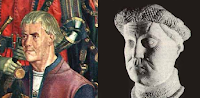
The "real" Henry the Navigator
Dom(*) Henrique of Portugal, Duke of Viseu (4 March 1394 – 13 November 1460), better known as Prince Henry the Navigator (Infante Dom Henrique), was a central figure in the early days of the Portuguese Empire and in the 15th-century European maritime discoveries and maritime expansion. Through his administrative direction, he is regarded as the main initiator of what would be known as the Age of Discovery. Henry was the fourth child of the Portuguese King John I, who founded the House of Avis. After procuring the new caravel ship, Henry was responsible for the early development of Portuguese exploration and maritime trade with other continents through the systematic exploration of Western Africa, the islands of the Atlantic Ocean, and the search for new routes. He encouraged his father to conquer Ceuta (1415), the Muslim port on the North African coast across the Straits of Gibraltar from the Iberian Peninsula. He learned of the opportunities offered by the Saharan trade routes that terminated there, and became fascinated with Africa in general; he was most intrigued by the Christian legend of Prester John and the expansion of Portuguese trade. He is regarded as the patron of Portuguese exploration. (Intro from Wikipedia)

(*) honorific prefix used in Portugal during the time of the Monarchy, equivalent of the english "Sir"

March 4, 1394 - Porto, Portugal - Infante D. Henrique (Prince Henry) of Portugal is born
March 2, 1408 - Évora, Portugal - John I settles in Évora for the Courts of Évora
April 7, 1408 - Évora - The court obtains a series of revenues to allow the 3 eldest children to set up their own Houses, with autonomy and each one having an individualized body of servants.
April 17, 1411 - Viseu, Portugal - Moves to live with the Court in Viseu
October 31, 1411 - While in Viseu - In Ayllon, representatives of Portugal and Castile sign a peace agreement between the two countries
August(?) 1(?), 1414 - Torres Vedras, Portugal - Council with Nun'Álvares Pereira, former Constable of Portugal during the wars of 1383-1385 =(START)
July 18, 1415 - Odivelas, Portugal - His mother, Philippa of Lancaster, receives communion and later at night has a vision "of our Lady to give her strength to accomplish the journey". She gives the last blessing to the infants, names them knights of Christ and offers them the swords with which they should fight on the journey to Ceuta
July 19, 1415 - Odivelas - Philippa of Lancaster dies, aged 55
Prince Henry in armour
with his trademark beard
and Arms of Duke of Viseu
(Jerónimos Monastery)
July 25, 1415 - Lisbon, Portugal - An army of 19,000 to 20,000 knights and soldiers (including english, galician and biscay) sail to Ceuta
July 28, 1415 - Lagos, Portugal - Stopover at Lagos, south coast of Portugal. The Prince and the men are informed that the objective of the expedition is the conquest of Ceuta
August 2, 1415 - Faro, Portugal - After setting sail from Lagos, the fleet is hit by a violent storm and is forced to anchor at Faro for 7 days
August 13, 1415 - Off Ceuta | Algeciras - The fleet appears for the first time off Ceuta, but incomplete, as a storm dispersed part of its units. Armada regroups in Algeciras
August 19, 1415 - Algeciras, Spain - The surprise effect was lost and Ceuta had received considerable reinforcements, however John I could not return to the kingdom in such an inglorious way because that would bring him discredit throughout Christendom. Assembling the Council, the King announces that they would return to Ceuta
August 21, 1415 - Ceuta - The portuguese armada arrives at Ceuta and the army lands
August 22, 1415 - Ceuta - Ceuta falls in portuguese hands - The three princes of the "Illustrious generation" - Duarte, Henry and Peter, are armed as knights
September 1(?), 1415 - Tavira, Portugal - King John lands at Tavira. He names Prince Peter as Duke of Coimbra and Prince Henry as Duke of Viseu
September 5(?), 1415 - Lisbon - King John I and the Princes return to Lisbon
October 23, 1415 - Lisbon - Letter to the Duke of Bourbon politely refusing the invitation for the princes and 16 other knights to participate in a tournament with him, because it was hoped to launch a new offensive in North Africa against the Moors of Fez soon
February 16, 1416 - Lisbon(?) - The King grants him the mayorship of Viseu. The documents of that day already refer to him as "Duke of Viseu and Lord of Covilhã"
February 18, 1416 - Lisbon(?) - He is charged of the government of Ceuta. It was up to him to organize, in the kingdom, the maintenance of that stronghold in Morocco
October 24, 1416 - Batalha - Transfer of the body of Philippa of Lancaster from Odivelas to the Batalha Monastery
January(?) 1(?), 1418 - Ceuta - Returns to Ceuta
January(?) 1(?), 1419 - While in Ceuta(?) - Prince Henry is appointed governor of the Southern Province of Algarve
May 25, 1420 - Tomar, Portugal - A representative of John I presents in Florence the application for the attribution of the Government of the Order of Christ to Prince Henry. He gains appointment as the Grand Master of the Military Order of Christ, the Portuguese successor to the Knights Templar, which had its headquarters at Tomar, in central Portugal. Prince Henry held this position for the remainder of his life, and the Order was an important source of funds for his ambitious plans, especially his persistent attempts to conquer the Canary Islands, which the Portuguese had claimed to have discovered before the year 1346
October 20, 1420 - Tomar - Obtains from the crown an authorization to hold a free fair in Tomar
November 24, 1420 - While in Tomar - Pope Martin V issues a Bull giving perpetual character to the appointment
January 18, 1424 - While in Tomar - The King gives him the Lordship of Alcáçovas
January 21, 1424 - While in Tomar - The King donates houses and land in Ribeira de Santarém, where the Duke of Viseu would install a soap-works
April 15, 1426 - Tomar - Letter to the judges and good men of Tomar on the norms to be observed in the collection of firstfruits and tithes
May 19, 1426 - Tomar - Gathers the General Chapter of the Military Order of Christ in Tomar
June 9, 1426 - Tomar - Letter to Pope Martin V
January(?) 1(?), 1427 - While in Tomar - Diogo de Silves discovers Santa Maria Island, Azores Archipelago
April 22, 1427 - While in Tomar - Prince Peter visits the English Court
April 18, 1428 - Lisbon - Buys houses in Lisbon, in the Parish of São Nicolau
September 22, 1428 - Coimbra - Attends the marriage of his older brother (and future King) Duarte
December 15, 1428 - Estremoz (near the castilian border) - Reception for the bride of the heir to the Portuguese Crown
January 12, 1429 - Avis - John I receives envoys from Philip, Duke of Burgundy to ask for Princess Isabel's hand in marriage. The famous painter Van Eyck paints the King and the Princess
June 4, 1429 - Sintra - The envoy of the Duke of Burgundy arrives with authorization for the marriage
July 25, 1429 - Palace of Alcáçova, Lisbon - Celebration of the marriage of Princess Isabel and the Duke of Burgundy by proxy in the Palace of Alcáçova (inside St.Jorge castle)
September 26, 1429 - Lisbon - Farewell parties (until the 28th)
September 30, 1429 - Lisbon - Accompanies Princess Isabel to the ship that would take her to Flanders
January(?) 1(?), 1431 - Lisbon(?) - He donates houses for the "General Study" to reunite all the sciences—grammar, logic, rhetoric, arithmetic, music, and astronomy—into what would later become the University of Lisbon. For other subjects like medicine or philosophy, he ordered that each room should be decorated according to each subject that was being taught
April 1, 1431 - Carmo Convent, Lisbon - King John I (and Prince Henry) visits his old comrade-in-arms Nun'Álvares Pereira, former Constable of Portugal, at his deathbead
October 12, 1431 - Lisbon - Buys houses in Lisbon and donates them to the University of Lisbon
October 30, 1431 - While in Lisbon(?) - The Peace Treaty of Medina del Campo is signed between Portugal and Castile
January 27, 1432 - Almeirim - Ratification of the Peace Treaty between Portugal and Castile
August 1(?), 1433 - Alcochete - The King (with Prince Henry) departs for Alcochete on advice of the doctors and princes, seeking to get better
August 11, 1433 - Lisbon - Feeling downcast, the king asks to be taken to Lisbon to die in his best home. He does charities at the Cathedral and asks to be shaved so he doesn't die ugly and misshapen
August 14, 1433 - Lisbon - King John I dies, aged 76
September 26, 1433 - Lisbon - Letter of Donatory Captaincies (Inauguration of the system)
October 25, 1433 - Lisbon - King John's body is taken from the Cathedral of Lisbon to the Monastery of Batalha
November 6, 1433 - Lisbon(?) - Appointed Curator of the Prince
November 17, 1433 - Sintra - Swearing-in ceremony for 20-months-old Afonso V
November 25(?), 1433 - Santarém - Courts of Santarém (until the end of the year)
January 20, 1434 - Pombal - Participates in a "composition" made in Pombal, at his inn, where he intervenes in disputes between his subjects
August 18, 1434 - Batalha - The remains of King John and Philippa of Lancaster are enclosed in the mausoleum that the king had built, a conjugal tomb
March 7, 1436 - Estremoz - Signs his will, taking his nephew Ferdinand as "Son and heir"
March 22, 1436 - Évora - Courts of Évora (until March 30th)
July 3, 1437 - Lisbon - Prince Henry takes command of the Armada prepared for the conquest of Tangier. The nobility do not join the expedition en masse as in 1415
July 12, 1437 - Lisbon - Processions and visit of the royal family to the tomb of Constable Nuno Álvares Pereira. Prince Henry takes the Constable's banner with him
August 17, 1437 - Lisbon - Solemn ceremony at the Lisbon Cathedral - Prince Henry receives the Royal standard from the King
August 22, 1437 - Belém, Lisbon - The portuguese fleet departs Tagus River for Tangier, with Henry the Navigator and Prince D.Fernando aboard
August 27, 1437 - Ceuta - The fleet arrives in Ceuta. Prince Henry decides to continue rather than wait for the troops left behind due to lack of transport. Initially, an expedition of 14,000 men was expected, but only 43% of that landed, about 6,000
September 9, 1437 - Ceuta - Prince Henry's overland column leaves Ceuta
September 13, 1437 - Tangier, Morocco - The army reaches Tangier
September 20, 1437 - Tangier - The first assault to Tangier fails when the portuguese have to withraw with too few (and short) scaling ladders
September 30, 1437 - Tangier - The King of Fez arrives with a relief army
October 3, 1437 - Tangier - While the Portuguese are concentrated to face the army of the King of Fez, the Tangier garrison leaves in a sortie against the siege camp but are defeated by a Portuguese reserve force
October 5, 1437 - Tangier - A second assault to Tangier also fails, even with improved scaling ladders, a new siege tower and two large ordenance cannons shipped in from Ceuta
October 9, 1437 - Tangier - A second and huge Moroccan relief army arrives, made up of "many kings" (Fez, Marrakech, Sijilmassa, Velez, etc.). They soon charge violently against the Portuguese, relieving the pressure on Tangier and encircle them in their camp, effectively cutting them off from their ships. Prince Henry's horse is killed under him and the prince is rescued by a small group of guards when he is already in the midst of the Moroccan cavalry.
October 10, 1437 - Tangier - The moroccans launch another attack on the siege camp but are repelled. The situation for the portuguese becomes critical, with food and water running out and the army reduced to half
October 12, 1437 - Tangier - A truce is called and negotiations are opened
October 17, 1437 - Tangier - A treaty is signed by Prince Henry and Salah ibn Salah, emir of Tangier. The portuguese are allowed to return to their ships unmolested, but had to leave all their equipment behind, from horses and artillery to personal weapons. Also, Prince Henry promises to deliver Ceuta to the moroccans and commits Portugal to 100 years of Peace with the North African muslim States. As part of the agreement, both parts swap hostages. Salah ibn Salah hands over his son to the portuguese and in return, the portuguese leave four nobles with the moroccans. As a guarantee of fulfillment of the treaty terms, Prince Ferdinand remains as a hostage of Salah ibn Salah until Ceuta is returned
October 19, 1437 - Tangier - The fleet sets sail to Portugal, via Ceuta. Order of the Garter knight Álvaro Vaz de Almada and marshal Vasco Fernandes Coutinho are the last men to leave the beach. When the embarcation is complete, Prince Henry decides not to release Salah ibn Salah's son. In response, Salah ibn Salah dispatches the four portuguese nobles as prisoners to Asilah.
October 21(?), 1437 - Ceuta - Prince Henry lands in Ceuta and plunges into depression
January 25, 1438 - While in Ceuta - King Duarte summons the Courts of Leiria
February 25, 1438 - Beja, Portugal - Prince Henry meets King Duarte in Beja, then returns to Algarve
April 21, 1438 - Faro, Algarve - Letter from Faro, Algarve
May 25, 1438 - While in Faro - Prince Ferdinand is transfered from Asilah to Fez
June 1(?), 1438 - Portel, Algarve - King Duarte, his older brother, dies in Tomar, aged 47. Henry's nephew and sucessor to the throne, Afonso V, was only 6-years-old, so the Queen consort of Portugal, Eleanor of Aragon, is appointed Regent of Portugal
September 30(?), 1438 - Tomar - Arrives in Tomar
The traditional Prince Henry
in "Chronicles of Guinea" (1455)
is actually King Duarte
in courtly clothes
December 24, 1439 - Lisbon - Courts of Lisbon - The princes overcome the Queen's opposition, bringing the child Afonso V to the National Assembly, for the solemn act of confirmation of the regent by the monarch
May 8, 1440 - Lisbon(?) - The Prince signs the Captaincy letter granted to Tristão Vaz Teixeira for the Captaincy of Machico, Madeira
February 12, 1441 - Lamego - The troops of the Duke of Coimbra (Prince Peter) join those of the Duke of Viseu (Prince Henry)
May 1(?), 1441 - Torres Vedras - Courts of Torres Vedras
February 10, 1442 - Letter to the Pope
May 25, 1442 - Óbidos - Formal commitment ceremony of the marriage of Afonso V and Lady Isabel, daughter of the Duke of Coimbra (both minors)
October 18, 1442 - His younger brother, Prince John, Constable of Portugal, dies at Alcácer do Sal, aged 42
April(?) 1(?), 1443 - Lagos - Returns to Lagos in the Spring
June 5, 1443 - While in Lagos - Prince Ferdinand dies in captivity in Fez at age 40, henceforth known as the "Holy Prince"
The only painting of Prince Henry
made during his lifetime, as Master
of the Order of Christ,
on the panels of São Vicente (1450s).
Without his trademark beard but
with the white hair he's had since his 20s,
an Order of Christ necklace
and an Order of Garter belt
August 23, 1443 - Letter to the University of Lisbon
October 22, 1443 - Letter from the King granting him the exclusive navigation south of Cape Bojador (Western Sahara)
October 27, 1443 - The Crown grants him, for life, the area of Cape St.Vincent and the surrounding area within a radius of one league
September 1(?), 1444 - Lagos - In Lagos until the end of the year
April 17, 1445 - Tentúgal - Prince Henry arrives early at Tentúgal for a Council meeting
April 25, 1445 - Tentúgal - Council meeting to decide on sending a host to Castile to help Castilian Constable D. Álvaro de Luna. Confers the honor of Constable to Prince Peter in Coimbra
August 28, 1445 - Receives a donation from the Woad dyeing (Isatis tinctoria) monopoly, an industry that he himself had introduced in the Kingdom
September 28, 1445 - Coimbra - Attends the marriage of the daughters of Prince John
February 3, 1446 - Obtains from the Crown the exclusivity of navigation to the Canary Islands
June 23, 1446 - Raposeira, Algarve - At Raposeira, Algarve
August 8, 1446 - Lagos, Portugal - Arrival of the first 235 slaves in Portugal
November 1, 1446 - Sagres - The Prince signs the Captaincy letter granted to Bartolomeu Perestrelo for the Captaincy of Porto Santo, Madeira Archipelago
March 1(?), 1447 - Évora - Courts of Évora
April 1(?) 1447 - Lisbon - Resides in Lisbon until June
May 6, 1447 - Santarém - Attends the marriage of King Afonso V and Isabel of Coimbra (both 15 years old)
June 1(?), 1447 - Lisbon - Leaves Lisbon
March 9, 1448 - Completes the purchase of the Island of Lanzarote (Canary Islands) from Maciot de Bethencourt
March 25, 1448 - The Duke grants 10 silver marks a year to the University of Lisbon "forever", paid by him and his heirs
July 11, 1448 - While in Algarve - King Afonso V assumes the government of the Kingdom
August 1(?), 1448 - Lisbon - Travels from Algarve to Lisbon
October 1(?), 1448 - Coimbra - Conference with Prince Peter
February 1(?), 1449 - Santarém - King Afonso V and Prince Henry set out to Santarém
The traditional Prince Henry
in the "panels of St.Vincent" (1450s)
is again King Duarte
in courtly clothes
April 1(?), 1449 - Santarém - Council meeting
April 27, 1449 - Coimbra - Afonso V tries to attack Coimbra but Prince Peter leaves the city on May 5
May 16, 1449 - Alcoentre - Skirmishes between forces of King Afonso V and Prince Peter
May 20, 1449 - Vialonga, Alverca, near Lisbon - Battle of Alfarrobeira - Prince Peter is killed along with the Count of Avranches, Álvaro Vasques de Almada, knight of the Order of Garter
May 24, 1449 - Lisbon - After spending three days on the battlefield, Prince Henry returns to Lisbon with the King
May 27, 1449 - Lisbon - Afonso V appoints Prince Henry Governor of the Military Order of
Avis
November 4, 1449 - Lisbon(?) - Receives the donation of Baleal and the Berlengas Islands
January 15, 1450 - The Crown grants him the exclusive rights of coral fishing in the seas of the Kingdom for 5 years and its sale
February 3, 1450 - The Prince signs the Captaincy letter granted to Jacob van Brugge (Jácome de Bruges) for the Captaincy of Terceira Island, Azores Archipelago
November 1, 1450 - The Prince signs the Captaincy letter granted to João Gonçalves Zarco for the Captaincy of Funchal, Madeira
May 18, 1451 - Lisbon(?) - Authorized to build windmills in the Tagus River Valley
The incredible similarity between
he painting of the São Vicente Panels
and the effigy on his tomb.
July 31, 1451 - Vila Franca de Xira - Receives the ambassadors of Emperor Frederick III in Vila Franca
August 9, 1451 - Lisbon - Arrives in Lisbon with the ambassadors
December 8, 1452 - Letter to João Gonçalves Zarco, in Madeira
April 1(?), 1454 - Afonso V donates the Coast of Guinea to Prince Henry
May 1(?), 1455 - Sagres - Spends the month of May in Sagres
December 2, 1455 - Évora - The young Queen Isabel dies at the age of 23, with suspicion of poisoning
January 2, 1456 - Batalha - Deposit of the bones of Queen Leonor next to King Duarte in Batalha Monastery
January 1, 1457 - Obtains the mayorship of Silves, in Algarve
December 26, 1457 - Sagres - Donation of 5% of the profits from the Guinean business to the Order of Christ
September 30, 1458 - Lisbon - King Afonso V (and Prince Henry) sail for Morocco with an embarked army of 25,000 men
October 3, 1458 - Sagres - The fleet anchors at Sagres
October 17, 1458 - Lagos - The fleet sails from Lagos
Prince Henry's effigy
(note the arms of Duke of Viseu)
October 21, 1458 - Alcácer Ceguer (Ksar es-Seghir, Morroco) | Ceuta - 
Conquest of Alcácer Ceguer. Then the King and the Prince go to Ceuta
November 16, 1458 - Ceuta - Prince Henry and the King sail for Algarve
January 1(?), 1459 - Évora - Travels to Évora to stay with the Court
July 2, 1460 - While in Sagres - Afonso V deliberates that the town of Lagos would not be given to anyone else after the death of Prince Henry and that it would revert to the Crown
September 1(?), 1460 - Sagres - Testamentary letters
October 28, 1460 - Sagres - Last Will and Testament
November 13, 1460 - Sagres - Prince Henry the Navigator dies, aged 66 =(END)